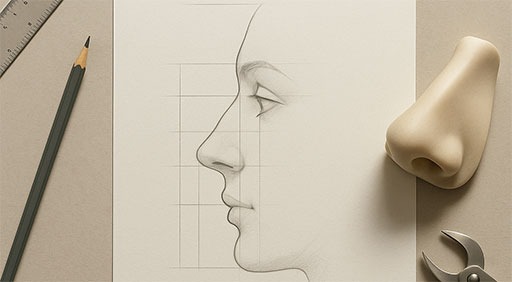
Proportion First: Where CO2 Laser Rhinoplasty Actually Fits
Harmony begins with proportion: dorsal contour, radix height, tip projection, and the nasolabial angle. Against that backdrop, “CO2 laser rhinoplasty” is not its own category of operation but an adjunct. A CO2 laser may help with meticulous soft-tissue work, hemostasis, or selective resurfacing, which can tidy edges and manage bleeding. It does not by itself narrow a bony vault, rotate a tip, or reposition cartilage. In other words, it is a scalpel made of light, valuable for finesse but not a stand-alone method for architectural reshaping. For patients expecting structural change, the conversation still returns to cartilage grafts, osteotomies, and suture techniques. For skin-level texture around the nose, controlled resurfacing may polish the canvas, but it does not reengineer the frame beneath it.
Decoding A “Laser Nose Job” Claim Without The Hype
“Laser nose job” reads like the future, but most of the heavy lifting in contour and airway work remains mechanical. Lasers excel at soft-tissue precision; bone and cartilage respond to planned cuts, grafts, and sutures. When you see broad claims, translate the language into mechanics. If the promise is a straighter bridge, ask how dorsal irregularities are addressed. If the goal is tip definition, ask what sutures, grafts, or deprojection maneuvers are planned. If breathing is a priority, ask about internal valve support and septal strategy. These are the signals that drive outcome quality more than whether light was involved.
Beyond The Tool: What Shapes Ultrasonic Rhinoplasty Price
Piezoelectric instrumentation applies ultrasonic energy to bone, allowing controlled cuts and polishing that spare nearby soft tissues. The appeal is accuracy, reduced collateral trauma, and smoother contouring of the bony vault. What influences cost in practice is case complexity, surgeon experience, operative time, anesthesia, facility standards, imaging, and postoperative care. Geography and revision risk also matter. While it’s tempting to chase a number, the smarter move is to interrogate the value chain: technique fit for your anatomy, revision statistics, and follow-up protocols. For compliance and clarity, concrete prices are avoided in content connected to ad units; guidelines recommend not mentioning specific price points or “cheap/affordable” claims to prevent confusion and misaligned expectations .
Small Volumes, Big Optics: Precision In Nose Reshaping With Fillers
“Nose reshaping with fillers” camouflages, it does not reduce. Hyaluronic acid can soften a radix depression, mask a small dorsal step, or even out minor asymmetries that create distracting light breaks. Because the technique adds volume, outcomes should aim for optical smoothing rather than subtraction. Safety rests on anatomy-aware planning, conservative dosing, and respect for vascular zones. The highest returns come from micro-adjustments under neutral lighting and calm head position, with readiness to reverse if the aesthetic read misses the brief. Longevity depends on product rheology and individual metabolism; reversibility is a reassuring safety net, not an excuse to push volume.
When Trade-Offs Favor Nose Reshaping Non Surgical Paths
Non-surgical options can be attractive when downtime must be minimal and the targets are optical—a slightly smoother profile for photos, a softened radix, or a temporary trial of proportion. They do not narrow a wide bony vault, rotate a tip in a durable way, or fix internal valve issues. Think of them as a reversible dress rehearsal for select contours. Where reduction is the aim—lowering a true hump, refining width, or correcting functional problems—camouflage will always stop short, because it can smooth edges but cannot subtract structure.
Planning, Language, And Stable Outcomes In Rhinoplasty Surgery
Technique names are useful but incomplete. “Open” and “closed” describe access, not artistry; “ultrasonic” describes a power source, not judgment. Reliable planning walks through scaffold, stability, and soft-tissue redraping: how the dorsum is preserved or reduced, how spreader grafts maintain internal width, how tip support is built so rotation and projection hold their line as edema resolves. The follow-through—edema management, splinting, tape, and staged return to activity—shapes early reads and long-term symmetry. In complex noses, predictability often comes from a conservative plan executed precisely rather than a maximal plan that chases every millimeter in one sitting.
A Qualitative Comparison For 2025: Options Within Rhinoplasty Surgery And Adjacent Methods
Compliance note: price figures are deliberately omitted; guidance advises avoiding concrete numbers and “cheap/affordable” phrasing in content paired with ad units .
|
|
|
|
|
|
|
|
|
|
|
|
|
|
|
|
|
|
|
|
|
|
|
|
|
|
|
|
|
|
|
|
|
|
|
|
|
|
|
|
|
|
|
|
|
|
|
|
|
|
|
|
|
|
Downtime, Longevity, And Revision Signals After Rhinoplasty Surgery
Healing has its own logic. Early reads are dominated by edema and the way soft tissue redrapes onto a newly sculpted scaffold. Thicker skin blunts early definition at the tip but often ages softly; thinner skin shows detail quickly but requires judicious smoothing of dorsum and tip transitions to avoid edge visibility. True symmetry is bounded by baseline anatomy; a millimeter can be both visible and physiologically realistic. Revision discussions make most sense after the tissue settles and photographic reads are consistent across lighting, head position, and expression. Non-surgical camouflage can bridge small residuals once the framework is stable.
FAQ: Practical Questions Behind A “Laser Nose Job” Or Fillers
What’s the role of a CO2 laser during surgery? It can refine soft-tissue handling and hemostasis, occasionally assist with skin texture around the nose, but it does not reshape bone or cartilage.
How do fillers differ from surgical change? Fillers add volume to smooth or balance; surgery removes, repositions, or reinforces structures to change contour and airflow.
Is ultrasonic instrumentation a different operation? It’s a way to work on bone more precisely within the same operation; outcomes still depend on planning, grafts, and sutures.
When might camouflage be smarter? For select depressions or minor asymmetries where a reversible optical fix is enough, especially when downtime must be minimal.
Conclusion: A Clearer Way To Choose
A measured profile comes from decisions anchored in anatomy, not slogans. Energy-assisted tools can refine how a surgeon works; fillers can finesse how light reads across the bridge and radix. But durable architecture—when reduction, support, or breathing is at stake—still lives in carefully planned structural maneuvers.
Your most productive step is to translate each promise into a mechanic, then weigh the trade-offs you can live with: permanence versus reversibility, downtime versus immediacy, camouflage versus change. This approach keeps expectations realistic and guides you toward techniques that match the face you see and the function you need.